

When most people imagine Barcelona, their minds conjure the technicolor bursts of Park Güell or the kaleidoscopic stained glass inside the Sagrada Família. But long before Modernisme brought blue ceramic glazes and emerald glass to the Mediterranean, Barcelona was defined by a far quieter, deeply organic palette: warm ochres, clay reds, and dark charcoal iron.
If you wander though the Ciutat Vella (the 'old city'), sneak away from the crowded thoroughfares and stand still in the Gothic Quarter, you'll find yourself surrounded by buildings made out of the literal geology of Catalonia.
In Part 1 of our Colors of Barcelona series, we peel back the modern urban layer and take a walk through history to examine the foundational tri-color palette that built the ancient city.
1. Montjuïc Sandstone: The Warm Grey Baseline
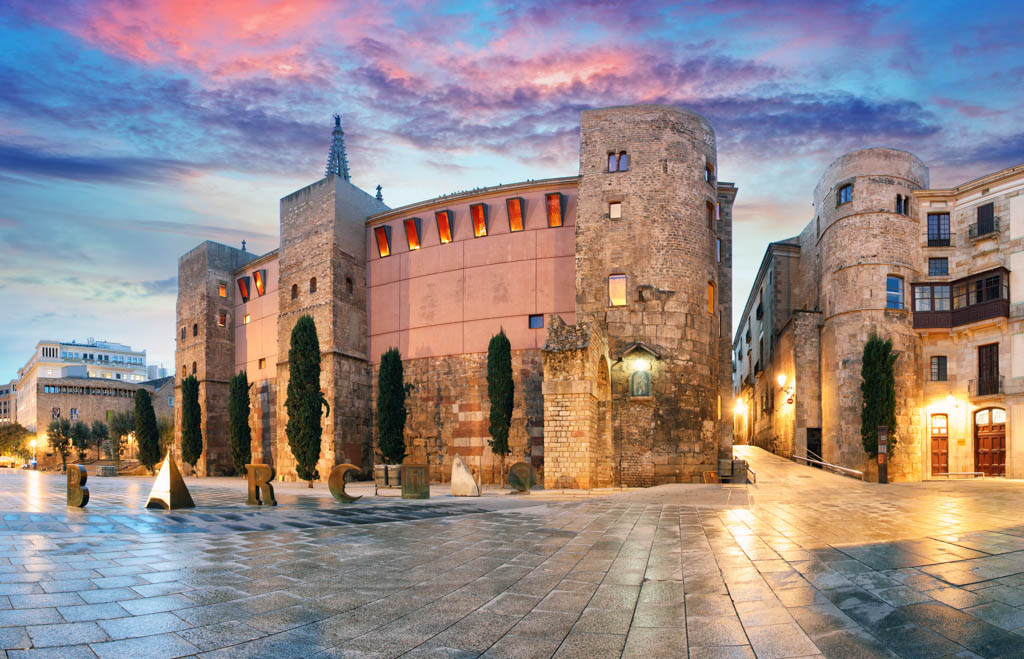
If Barcelona has a single dominant visual foundation, it is Montjuïc Stone (Pedra de Montjuïc)—the foundational canvas that dictates the city’s quiet, ambient color temperature.
Quarried from the coastal hill overlooking the port from Roman times until the middle of the 20th century, this unique sandstone is rich in quartz crystals and oxidized iron. When newly cut, its raw palette ranges from pale ash greys to delicate golden sand and soft straw ochres. Over centuries of exposure to salty Mediterranean air, moisture, and urban weathering, the mineral oxides react, creating a distinct patina that matures into a deep, toasted amber and honeyed tan.
The Bedrock of Barcelona Architecture
Virtually every monumental structure built in Barcelona prior to the 1950s owes its physical existence—and its warm neutral hue—to Montjuïc:
- Ancient Barcino: The dense, 3rd-century Roman walls and city gates whose weathered stone blocks shift from pale granite greys to warm wheat tones in direct light.
- Gothic Masterpieces: The Cathedral of the Holy Cross and Saint Eulalia, Santa Maria del Mar, and the Palau de la Generalitat, all featuring massive blocks of Montjuïc stone that absorb and reflect the soft ambient glow of the narrow medieval alleyways.
- Modernisme & Eixample: Antoni Gaudí selected Montjuïc stone for the load-bearing pillars and lower facade of the Sagrada Família and the undulating base of Casa Milà (La Pedrera), relying on its high compression strength and its rich, biscuit-colored warmth to ground his organic designs.
Because the quarries were officially closed in 1957 to preserve the hill for parkland, original Montjuïc stone is now a finite, highly prized historical artifact. Today, restoration work on monuments like the Sagrada Família relies on stockpiled stone blocks retrieved from demolished historical buildings around the city, ensuring any new additions match the exact mineral tone and weathering profile of the original masonry.
Dark History: The Gravestones of El Call
One of the most complex and historical chapters of Montjuïc stone lies hidden in plain sight within the walls of medieval buildings—including the Episcopal Palace (Palau Episcopal) and sections of the Cathedral precinct.
In August 1391, anti-Jewish pogroms swept through Barcelona, devastating El Call (the Jewish Quarter). Following the destruction and the eventual expulsion of the Jewish community in 1492, the ancient Jewish cemetery located on the slopes of Montjuïc—which had stood for centuries—was dismantled.
Faced with high costs to quarry fresh rock from the hill, medieval builders repurposed the heavy, pre-cut Montjuïc stone gravestones (masseroth) as raw construction material. Today, if you walk along Carrer del Bisbe or inspect the walls near the Plaça del Rei, you can still spot these ochre blocks with medieval Hebrew inscriptions carved directly into the stone face—turned upside down or sideways by stonemasons who treated them purely as functional building material.
Where to spot it:
- The Roman Walls (Plaça del Rei): Look at the sheer, dense blocks forming the base of the medieval towers. The golden-amber tint in the stone highlights quartz pockets that catch and scatter Mediterranean sunlight.
- Santa Maria del Mar: Known as the Cathedral of the Sea, this 14th-century Catalan Gothic masterpiece showcases how uniform blocks of Montjuïc sandstone create a towering, monolithic facade of soft sand and warm taupe tones.
💡Visual Tip: Watch how Montjuïc stone acts like a color chameleon throughout the day. Under the sharp, flat mid-day sun, the quartz dominates, making walls appear cool, pale, and stony grey. As golden hour approaches, the oxidized iron ignites under the low-angle light, transforming the ancient masonry into a soft, honeyed gold. If you want to train your eye to capture these subtle shifts on camera, we explore these exact lighting conditions on our Barcelona photography walk and color hunt.
2. Terracotta and Baked Clay: The Mediterranean Roofline
Look up from the narrow alleyways of El Born or El Raval, and the palette shifts dramatically from heavy, cool stone to a warm, sun-baked wash of earthy clay tones.
The Catalan rajola (ceramic tile) and traditional curved roof tiles (teula àrab) were born out of practical necessity. Clay harvested from nearby riverbeds like the Besòs and Llobregat was cheap, abundant, fireproof, and excellent at insulating homes from the scorching Mediterranean summer heat. When fired in kilns, the iron-rich local river silts transformed into a spectrum of rich sienna, rustic copper, and muted salmon pinks.
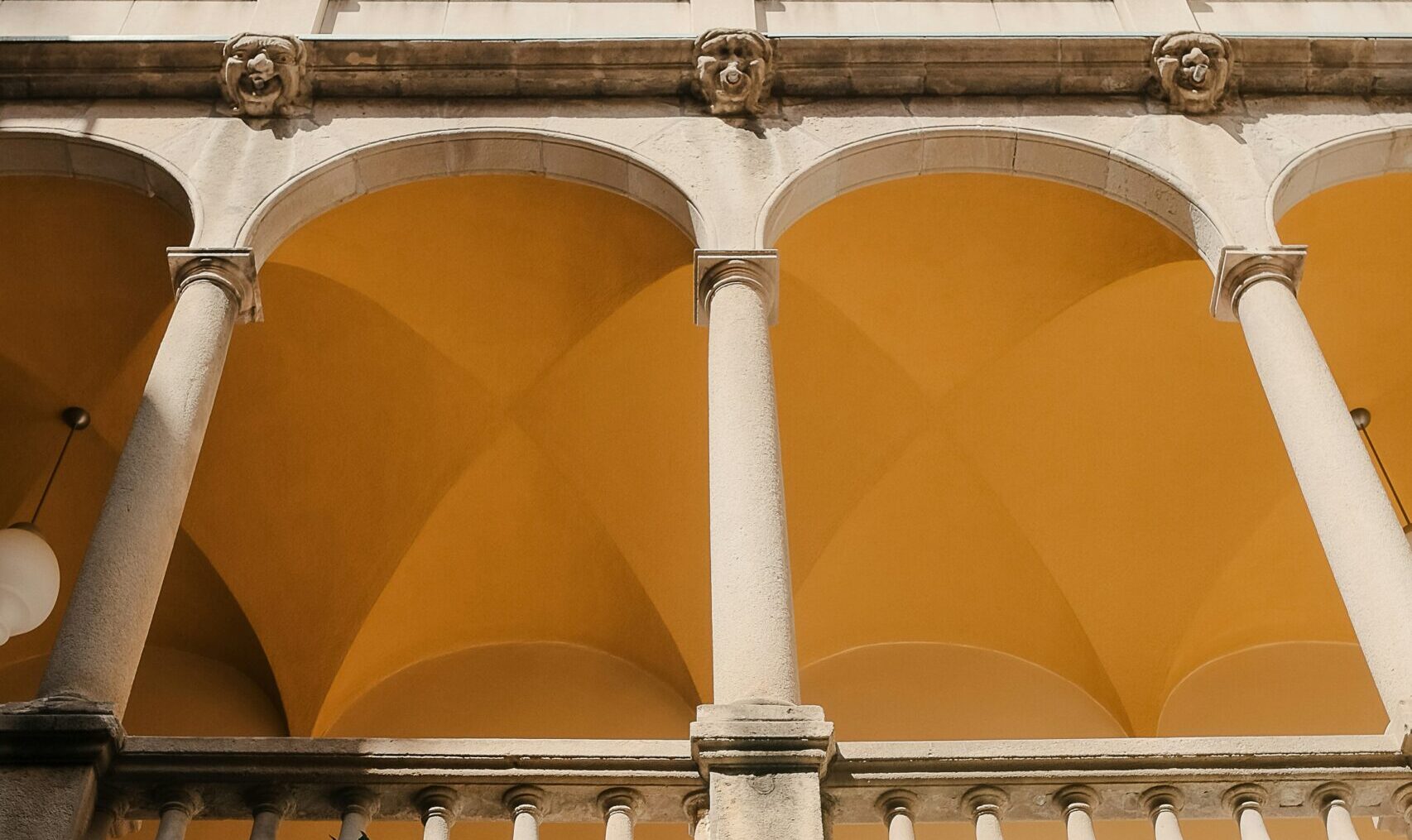
Long before decorative glazed tiles brought vibrant color into Catalan homes, raw terracotta was the unsung workhorse of urban construction. It formed the structural backbone of the classic volta catalana (Catalan vault)—an ingenious architectural technique using layered thin brick tiles to span wide ceilings without requiring heavy wooden beams. This lightweight, fire-resistant design allowed medieval and early industrial builders to build upward, creating layered ceilings where warm mahogany-brown wood and pale peach-colored clay bricks rested side-by-side.
This baked terracotta red became the defining shade of Barcelona's skyline. Seen from above, it forms an iconic high-contrast boundary—a sea of burnt orange and warm brick separating the deep turquoise blue of the Mediterranean sky from the dusty, neutral stone streets below.
The Evolution into Exposed Brick
During the 19th-century Industrial Revolution, clay evolved from humble roof tiles and hidden structural vaults into bold, exposed brickwork. As Barcelona's Poblenou district rapidly transformed into the industrial workhorse of the city (coming to be known as the "Manchester of the South"), industrialists abandoned heavy stone in favor of high-fired, deep crimson brick to erect textile mills, warehouses, and towering factory chimneys.
In neighborhoods like El Poblenou and Sant Andreu, these deep red and rusty mahogany brick structures—such as the iconic Can Batlló and Fabra i Coats—solidified terracotta as the literal engine room color of the expanding city. Even as modernism took root, visionary architects like Lluís Domènech i Montaner embraced raw brick as a symbol of Catalan identity, weaving its warm burnt-umber tones directly into landmark designs like the Castell dels Tres Dragons in Ciutadella Park and the sprawling, coral-roofed Sant Pau Recinte Modernista.
Where to spot it:
- El Poblenou Factory Chimneys: Walk along the Passatge de Masoliver or Rambla del Poblenou to see freestanding 19th-century industrial chimneys piercing the sky in rich, weathered terracotta brick that shifts from dark cinnamon to bright rust in the afternoon sun.
- The Rooftops of El Born: Head to a rooftop terrace near Santa Maria del Mar for a bird's-eye view of the interlocking teula àrab rooflines—an undulating sea of apricot, burnt sienna, and weathered clay stretching toward the coastline.
- Castell dels Tres Dragons: Located at the edge of Parc de la Ciutadella, this 1888 Universal Exposition building showcases an extraordinary chromatic contrast between exposed industrial red brick and stark white decorative ceramics.
💡Visual Tip: Pay attention to the subtle color shifts between older terracotta tiles and industrial brick. Hand-molded 18th-century roof tiles feature dynamic variations—ranging from pale peach and warm sand to burnt sienna—because of uneven firing temperatures in historic wood-burning kilns, whereas 19th-century factory bricks offer a dense, uniform crimson.
3. Charcoal & Forged Iron: The Accent Line
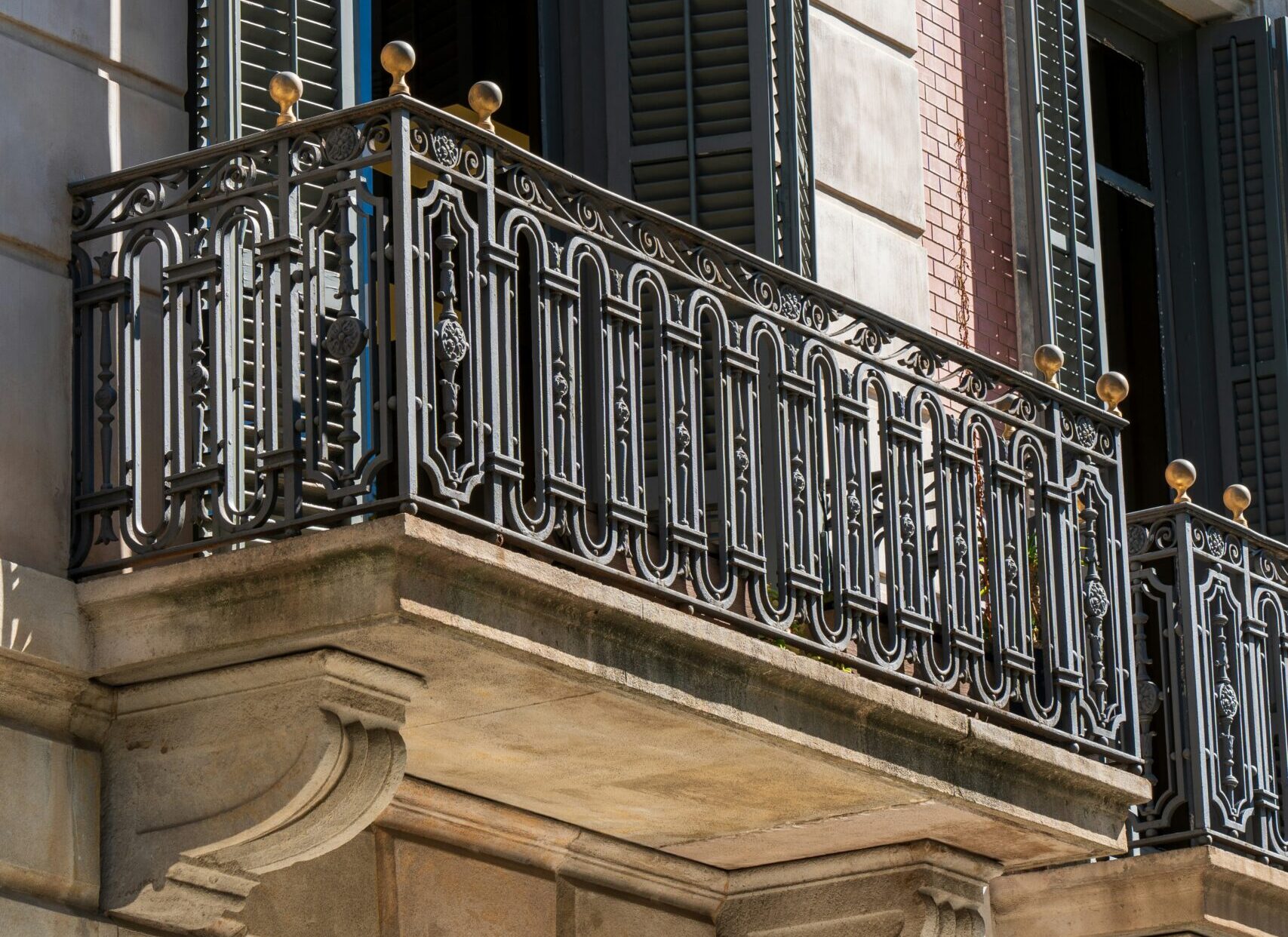
The third element in Barcelona's foundational chromatic triad is Wrought Iron (Ferro Forjat)—the deep slate-black accent line that brings structure to the city’s warm architectural canvas.
From medieval window grilles (reixes) forged for defense to intricate 19th-century balcony brackets hanging over Eixample, charcoal-toned iron provides the necessary visual contrast that anchors Montjuïc’s honeyed stone and terracotta’s burnt orange tones together.
Color theory teaches us that warm, low-contrast palettes need a cool or dark ground to prevent them from washing out under bright sunlight. Without the stark framing of forged iron, the soft ochres, dusty ambers, and clay reds of Old Barcelona would bleed into a uniform, low-contrast blur. The deep, graphite-black lines act as a high-contrast ink drawing laid over a watercolor wash, creating sharp geometric boundaries that make the surrounding warm pigments appear richer and more saturated.
From Guild Workshops to Modernista Flourishes
Blacksmithing was one of medieval Barcelona’s most prestigious trades, centered around the historic Carrer dels Mirallers and the Born district where guild masters hammered raw iron into protective window guards, heavy door studs, and street lamps. These early wrought-iron elements were coated in coal-tar linseed oils, giving them a matte, dark-charcoal finish that resisted the corrosive Mediterranean sea air.
As Barcelona transitioned into the 19th century, iron evolved from a purely functional barrier into an expressive, organic art form. Modernista masters like Antoni Gaudí and Joan Busquets treated black iron almost like dark liquid paint, twisting heavy bars into whiplash curves, dragon scales, and botanical tendrils across building facades. Against pale sandstone walls, these dark charcoal silhouettes cast moving shadows throughout the day, constantly altering the visual weight and color temperature of the building face. Noticing how these high-contrast accents ground the city's palette is central to The Chromatic Lens tour in Barcelona, where we focus on framing the urban landscape through color, texture, and light.
Where to spot it:
- Gothic Quarter Window Grilles (Reixes): Explore Carrer de la Pietat behind the Cathedral to see raw, hand-hammered 14th-century iron bars whose dark, oxidized surfaces contrast sharply against pale Gothic masonry.
- Casa Vicens Balconies: Gaudí’s first major residential masterpiece features cast-iron palm frond railings where dark charcoal steel frames vibrant green and yellow ceramic tiles.
- Palau Güell Entrance Arches: Located off La Rambla, these massive parabolic forged-iron gates display complex seaweed and dragon motifs, showcasing how dark iron can create dramatic entryways against Montjuïc stone.
💡Visual Tip: For photographers, iron details are all about managing high dynamic range. Look for backlit balconies during mid-afternoon sun: the deep charcoal metal acts as a crisp silhouette framing bright terracotta walls behind it.
Summary Palette for Visual Artists.
If you're a designer, photographer, cinematographer or a practitioner of any other visual art, and you're currently curating a project inspired by Old Barcelona, here is an original, interactive color historical swatch which explores the dance of light and color throughout a typical Barcelona day:
The Foundation Palette
See how Barcelona's coastal light alters stone and tile tones
Montjuïc Ochre
Quartz-rich sandstone of Roman & medieval walls
Terracotta Red
Sun-baked clay tiles and historical industrial brick
Gothic Slate
Weathered medieval masonry and shaded alleys
Forged Iron
High-contrast wrought iron grilles and balcony lines
Coming Up in Part 2: The Modernista Color Explosion
Now that we've established the raw, earthy foundation of ancient Barcelona, what happens when 19th-century architects decide to break the rules?
In Part 2, we explore my favorite part of Barcelona's rich history: how Gaudí, Jujol, and the Modernisme movement shattered the stone monologue with vibrant trencadís mosaics, cobalt glazes, and hydraulic tile patterns.
Check in regularly, or subscribe to our newsletter to get Part 2 delivered straight to your inbox.
Ready to experience these tones in person?
Join a small group on The Chromatic Lens photo walk to discover hidden architecturtal details, learn local history, and practice color-focused street photography across Barcelona's historic neighbourhoods.

